“Sometimes a city speaks through a film that never ends.”
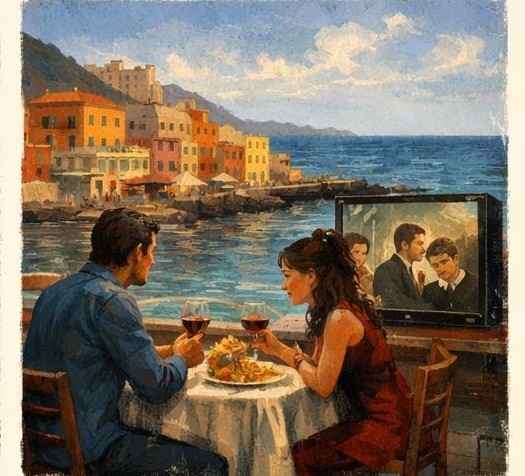
The fishing village of Bocadasse, on the outskirts of Genoa, is quiet during the afternoon. The waves roll gently under the radiant light of an October sun. In a small family restaurant, where the walls smell of the sea and the tables are simply set, I take a seat at a table opposite her. It is the only seat that is still available. ‘Buon pomeriggio,’ she says, while the smell of fresh pasta with pesto meets me.
Old posters of Italian films hang on the wall. My eye falls on the film Amarcord by Fellini. Just as I want to say that I have seen that film, she says, “Fellini knew that memory is always a sea. You can’t live in it, but you can return to it again and again.” I nod while my fork slowly rotates through the pasta. I taste the genius simplicity of pesto, which is not just a dish here but a tradition. I look out of the window, and as the waves play on the shore, I feel the sea flowing through my being — as if I myself were a frame in a film that never ends, and Genoa were the director.
We get to talking about Italian cinema. She says that Italian films are not just stories, but mirrors of a country that is constantly reinventing itself. “Rossellini, Visconti, Fellini — they taught us that the horizon is not just a place, but a feeling. “I listen, a glass of wine in hand, and think of the ships in the harbor, always ready to leave.
The conversation is light, yet deep. We laugh at a scene from Amarcord, which means ‘I remember.’ We share more memories of movies. Sharing creates a sense of connection. Her words linger, like seaweed on the quay — not intrusive, but always present. A conversation with a cosmic glow in which the sea, the film, and the meal together form a mirror.
It is already dark when we leave the restaurant. The moon climbs high in the sky and illuminates the sea. We stare at the ‘moonlight drive’… “Let’s swim to the moon”, she sings… I recognize the melody.
“ I cannot live without the sea” , she says… ” without that infinite, moving pool of joy and sorrow, in which Genoa reflects itself like an old film reel. “And you know, cinema is like the sea. You can watch it again and again, and yet it is always different.” Her voice blends with the sound of the waves. For a moment it feels as if the city and the sea are whispering a story together, and I know that Genoa has given me not only a horizon, but also a film that lingers — a memory that returns with each tide, and a promise that the future will carry new scenes yet to unfold.