


There is a reason W.B. Yeats famously wrote, “When I had come a little way from the road, I saw that the whole place was full of the beauty of the earth,” and meant it for Sligo. For the poet, this county in the northwest of Ireland was the source of his imagination, the “land of heart’s desire” where the boundary between the real world and the world of faery blurred. To visit Sligo today is to walk through the pages of his poetry. The landscape is dramatic, ranging from the brooding bulk of Benbulben to the gentle curves of Lough Gill, and it remains deeply intertwined with the man who immortalized it.
The Yeats Connection: More Than Just a Visitor
Yeats spent his childhood summers in Sligo with his mother’s family, the Pollexfens, who were sea captains and merchants in the town . While his family home was in London, Sligo provided the folklore, the wild scenery, and the “old country people” who told him stories of fairies, ghosts, and miracles.
“The world is full of woes, but I have found a place where the heart can be at peace.” – Yeats on Sligo
His poetry is saturated with Sligo geography. When he wrote of “The Lake Isle of Innisfree,” he was dreaming of the small island in Lough Gill where he stood as a boy. When he spoke of “the hillside” and “the woods,” he was often referring to the slopes of Benbulben or the forests of Glencar.
Places of Interest for the Literature Lover
If you are tracing Yeats’ footsteps, these are the essential stops:
1. Yeats Memorial Garden & Gravesite (St. Columba’s Church, Drumcliff)
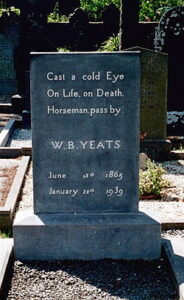

This is the pilgrimage site. Yeats is buried in the churchyard at Drumcliff, under the shadow of Benbulben. His tombstone bears his famous final instruction: “Cast a cold eye / On life, on death. / Horseman, pass by!”
- The Garden: Nearby, the Yeats Memorial Garden features native plants mentioned in his work and a statue of the poet.
- The Church: The church itself (built 1819) sits on the site of an older monastery founded by St. Columba.
2. Thoor Ballylee
Built in the 17th century, this Norman tower house was bought and restored by Yeats in 1917. He lived here intermittently until 1929. It was during his time here that he wrote some of his most mature and powerful work.
3. Lough Gill and Innisfree
Yeats wrote The Lake Isle of Innisfree while on a street in London, but the inspiration was the tiny island in Lough Gill.
- What to do: Take a boat tour from the Sligo Foyle or walk the trails around the lake. The Abbey Island, with its 15th-century abbey ruins, is another key spot.
4. Glencar Waterfall
The setting for The Stolen Child: “Down the glen, the waterfall / Is white and loud, / And the fairy folk are calling…”
- Access: A short walk from the parking lot leads to the base of the falls, surrounded by lush woodland.
5. The Yeats Centre (Sligo Town)
Located in the town, this modern center offers an interactive exhibition on Yeats’ life, his family, and his connection to the region. It is an excellent starting point for context.
The Region in His Poetry and Stories
Yeats didn’t just describe Sligo; he mythologized it. He transformed the local geography into a symbolic landscape.
- **Benbulben:** Often called “the table mountain,” this flat-topped peak
is the most iconic image in the county. For Yeats, it was a symbol of permanence and a gateway to the otherworld. It appears in Under Benbulben, his final poem.
- Rosses Point: A village where Yeats spent time, often associated with the sea and the fishing boats that feature in his early prose.
- The Folklore: Sligo was a hotspot for the Celtic Revival. Yeats collected many of the tales found in his books Fairy and Folk Tales of the Irish Peasantry directly from the locals in this region. The “slight people” (fairies) were not metaphors to them; they were neighbors, and Yeats treated them with the same seriousness as the physical world.
What to Do in Sligo Today
Beyond the literary trail, Sligo offers a rugged and beautiful experience:
- Hike Benbulben: The “Devil’s Kitchen” trail offers a challenging but rewarding climb with panoramic views of the entire county.
- Explore Strandhill: Just south of town, this surf town has a laid-back vibe, great coffee, and some of the best surfing on the west coast.
- Knocknarea Mountain: Home to the massive stone cairn of Queen Maeve (Caoine Mhaebh), a figure from the Ulster Cycle of mythology that Yeats also referenced. The hike to the top is steep but manageable.
- Dining: Sligo Town has a vibrant food scene. Try the fresh seafood at the harbor or the hearty Irish stew in one of the many traditional pubs like The Quays or The Longford’s.
How to Get There from Dublin
Getting from Dublin to Sligo is straightforward and scenic.
By Bus (Most Popular)
- Operator: Bus Éireann (Route 440) or Citylink.
- Duration: Approximately 2 hours 15 minutes to 2 hours 30 minutes.
By Car
- Route: Take the M4/M50 motorway west, then the N4 (National Primary Route) all the way to Sligo.
By Train
- Operator: Iarnród Éireann (Irish Rail).
- Duration: Approximately 2 hours 45 minutes.
Eternal landscape
Sligo is not just a place to visit; it is a place to feel. Walking the paths Yeats walked, standing beneath Benbulben, or looking out over Lough Gill, you understand why he felt such a profound connection to this land. Whether you are a literary scholar or just a traveler looking for dramatic Irish scenery, Sligo delivers an experience that resonates long after you leave. As you drive away, the image of the “horseman passing by” stays with you, a reminder that while we may leave, the landscape remains eternal.
To truly understand the soul of Sligo as Yeats saw it, you need to read the works where that landscape breathes life into his verses. Here are a few essential books that bridge the gap between the man and the region:
The Collected Poems of W.B. Yeats This is the definitive volume. You will find the specific Sligo poems here, including:The Lake Isle of Innisfree: Written in London but dreaming of the Lough Gill area in Sligo.
Innisfree and The Stolen Child: Both heavily inspired by the folklore and waters of Sligo.
Under Ben Bulben: Perhaps his most famous Sligo poem, written just before his death, where he famously instructs his heirs to “Cast a cold eye / On life, on death. / Horseman, pass by!” and specifies his burial on the mountain’s slope.
The Celtic Twilight, published in 1893, this collection of essays and tales is a perfect introduction to Yeats’s fascination with Sligo folklore. It documents the oral stories he heard from local people in his childhood, blending the real landscape with the supernatural. It explains why the region felt so magical to him.
The autobiographies of W.B. Yeats, specifically the sections covering his childhood in Sligo (often titled Reveries Over Childhood and Youth). This isn’t just a list of dates; it is a vivid, emotional reconstruction of growing up in the house by the sea in Strandhill and the time spent with his grandparents in Sligo town. It provides the context for the “dusk and dawn” and the “wild ducks” he frequently references.
The Wanderings of Oisin and Other Poems This early collection (1889) is steeped in the mythology of the region. Oisin is a long narrative poem about a warrior returning from the Tír na nÓg (Land of Youth), a place deeply rooted in Irish mythology that Sligo’s landscape seems to embody. Reading these while standing on the shores of Lough Gill or looking up at the silhouette of Ben Bulben creates a unique connection that few other places in the world can offer.


